



Breast Cancer
Radiation Therapy for Breast Cancer
Breast cancer is the most common type of cancer in American women, with nearly 213,000 women and 1,700 men expected to be diagnosed this year, according to the American Cancer Society. An additional 62,000 women will learn they have noninvasive, or in situ, breast cancer. Sadly, nearly 41,000 women and 500 men are expected to die from the disease this year. Still, breast cancer can often be cured, and about 80 percent of patients are free of the disease 10 years after their diagnosis.
Risk Factors for Breast Cancer
Many women who develop breast cancer do not have known risk factors. Patient qualities that may increase the risk of developing the disease include:
- Age is the biggest risk factor. More than 75 percent of women diagnosed with breast cancer are over age 50.
- Family history of breast cancer in your mother or sister.
- Early onset of periods.
- Having children later in life, or not at all.
- Hormone replacement therapy with estrogen and progesterone.
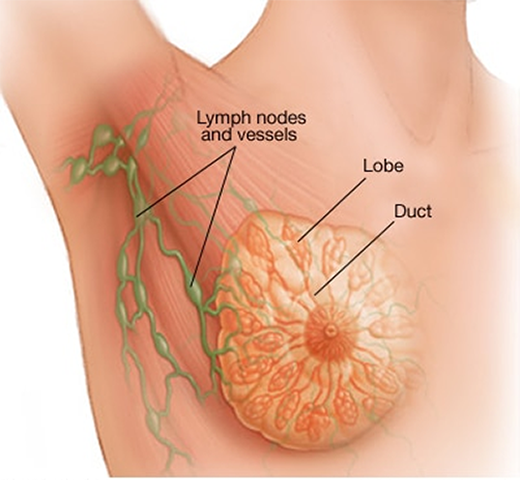
Being physically active, keeping a healthy weight, breast feeding and limiting alcohol intake may lower your risk for developing breast cancer.
Diagnosing Breast Cancer
Many breast tumors are first detected through a mammogram, a specialized breast X-ray. Women are advised to begin regular mammograms at age 40, and those with a family history or other risk factors should ask their healthcare provider whether earlier screening is appropriate. Any lump in the breast or underarm should be checked by a doctor, as should breast swelling, skin discoloration, dimpling of the skin, or nipple discharge. Along with a mammogram, your doctor may also recommend additional imaging, such as an ultrasound or MRI. If a mammogram is abnormal or a lump is found, a biopsy may be performed to determine whether cancer is present. This can involve using a small needle to remove tissue for examination under a microscope, though in some cases a surgeon may remove the entire lump to ensure an accurate diagnosis.
Treating Breast Cancer
The main treatment for breast cancer is surgery. This is often followed by radiation therapy. Some patients will also need chemotherapy and/or hormone blocking therapy.
- Breast conserving surgery is surgical removal of only the cancerous tissue. This operation is called a lumpectomy and is usually followed by radiation.
- Mastectomy is surgical removal of the breast.
- Both surgeries may be done in combination with tests that check the lymph nodes near the breast for cancer.
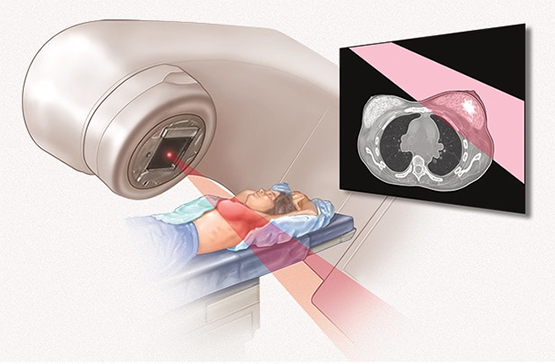
- Radiation therapy involves a radiation oncologist delivering radiation to the breast to destroy cancer cells. Radiation therapy works within cancer cells to make them unable to multiply. When these cells die, the body naturally eliminates them. Healthy tissue is able to repair itself in a way cancer cells cannot.
- Chemotherapy is medication prescribed by a medical oncologist to destroy cancer cells that may have traveled elsewhere in the body.
- Hormonal therapy is medication prescribed by a medical oncologist to block the effects of hormones that may be helping your tumor grow.
External Beam Radiation Therapy
Most often, radiation is directed only at the breast, though treatment may also include nearby lymph nodes if needed. A technique called 3-dimensional conformal radiotherapy (3D-CRT) uses multiple radiation beams to deliver highly precise doses to the breast while protecting surrounding healthy tissue. Side effects may include fatigue, skin irritation similar to a moderate sunburn, and mild to moderate breast swelling, all of which are temporary and can be managed with skin creams or medications. Be sure to tell your radiation oncologist or nurse about any discomfort you experience.
Accelerated Partial Breast Irradiation
External beam radiation therapy over several weeks is the standard of care. In national clinical trials, doctors are studying if accelerated partial breast irradiation (or APBI) — where radiation is delivered to only part of the breast over four to five days — works as well. These techniques are only available in a few clinics and then only to a select group of patients.
- Breast brachytherapy involves placing flexible plastic tubes called catheters or a balloon into the breast. Twice a day for five days, the catheters or the balloon are connected to a brachytherapy machine, also called a high dose rate afterloader. Your radiation oncologist then directs a special computer to guide a small, radioactive seed into the breast tissue near where the tumor was removed. The radiation is left in place for several minutes. After the end of the five days, the catheters or balloon are removed.
- 3-D conformal partial breast irradiation is where only part of the breast receives external beam radiation.
- Intra-operative radiation therapy (IORT) involves doctors delivering radiation to the breast during surgery.
The long-term results of these techniques are still being studied. Talk with your radiation oncologist for more information.
After Mastectomy Radiation
After a mastectomy, your doctor may suggest radiation therapy for the chest wall and nearby lymph node areas. Whether or not radiation therapy should be used after removal of the breast depends on several factors. These factors include the number of lymph nodes involved, tumor size, and whether or not cancer cells were found near the edge of the tissue that was removed. Many patients who have a mastectomy can safely skip radiation therapy. Ask your doctor for more information.

Contact Form
MACON
The Peyton Anderson Cancer Life Center
800 First Street
Suite 110
Macon, GA 31201
Phone: (478) 743-3466
WARNER ROBINS
114 Sutherlin Drive
Suite R
Warner Robins, GA 31088
Phone: (478) 287-6353