



Lung Cancer
Radiation Therapy for Lung Cancer
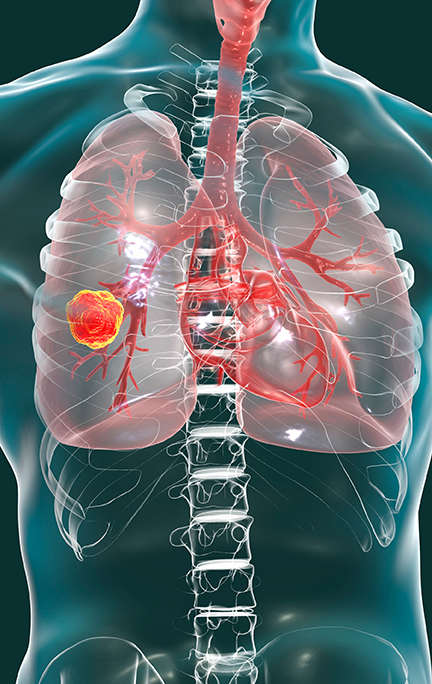
Lung cancer is one of the most common and serious types of cancer worldwide, affecting both smokers and non-smokers. It begins when abnormal cells in the lungs grow uncontrollably, forming tumors that can interfere with normal breathing and spread to other parts of the body. There are two main types: non–small cell lung cancer (NSCLC), which is the most common, and small cell lung cancer (SCLC), which tends to grow and spread more quickly. Because lung cancer often doesn’t cause symptoms in its early stages, many cases are diagnosed only after the disease has advanced.
Several risk factors increase the likelihood of developing lung cancer, with smoking being the most significant—responsible for the majority of cases. However, exposure to secondhand smoke, radon gas, asbestos, air pollution, and certain workplace chemicals can also raise risk. A family history of lung cancer, prior radiation therapy to the chest, and underlying lung diseases such as COPD further contribute to vulnerability. Importantly, even people who have never smoked can still develop lung cancer, making awareness and regular medical check-ins essential.
Signs and symptoms of lung cancer may vary but often include a persistent cough that doesn’t go away, coughing up blood, chest pain, shortness of breath, wheezing, hoarseness, or recurring respiratory infections like bronchitis or pneumonia. Some individuals may experience unexplained weight loss, fatigue, or loss of appetite. As the disease progresses, symptoms can become more noticeable and severe. Anyone who experiences these symptoms—especially if they have risk factors—should seek medical evaluation promptly, since early detection greatly improves treatment outcomes.
Diagnosing Lung Cancer
A chest X-ray often provides the first indication of a lung tumor, but CT scans and PET scans are commonly used to gather more detailed information. To confirm whether lung cancer is present, a biopsy is required, in which a small sample of lung tissue is examined for cancer cells. This biopsy may be performed during a bronchoscopy, a procedure in which a flexible, lighted tube is inserted through the nose or mouth to view the airways of the lungs. In some cases, a biopsy can also be done using a thin needle inserted through the skin directly into the tumor.
Treatment of Lung Cancer
Radiation therapy is a key treatment option for many people with lung cancer and can be used with the goal of curing the disease, controlling tumor growth, or relieving symptoms. External beam radiation therapy (EBRT) is the most common type, delivering high-energy X-rays from a machine outside the body to target the tumor. Advanced techniques such as three-dimensional conformal radiation therapy (3D-CRT) and intensity-modulated radiation therapy (IMRT) allow doctors to shape the radiation beams to the tumor while protecting surrounding healthy tissue. Another highly precise form, stereotactic body radiation therapy (SBRT), is often used for early-stage lung cancer in patients who are not good candidates for surgery. SBRT delivers very focused, high-dose radiation in just a few treatments and has been shown to provide excellent local tumor control.
In addition to external beam treatments, radiation may be combined with other therapies depending on the type and stage of lung cancer. For patients with small cell lung cancer, radiation is often given alongside chemotherapy to increase effectiveness. In more advanced cases, radiation can help shrink tumors that are causing symptoms such as pain, bleeding, or breathing difficulties. Throughout treatment, imaging is used to guide and refine therapy, ensuring accuracy as the tumor changes or shrinks. Your radiation oncologist will determine the best approach based on your specific diagnosis, overall health, and treatment goals.
External Beam Radiation Therapy
External beam radiation therapy targets your lung cancer. Radiation is given in a series of daily treatments, Monday through Friday. Treatments are painless and last less than 30 minutes.ncer and may be used alone or in combination.
- Conventional radiation therapy uses multiple radiation fields to target the cancer and keep radiation from healthy cells.
- 3-dimensional conformal radiotherapy (3D-CRT) combines multiple radiation treatment fields to deliver precise doses of radiation to the lung tumor.
- Tailoring each of the radiation beams to focus on the tumor targets the cancer while protecting nearby healthy tissue.
- Intensity modulated radiation therapy (IMRT) is a form of 3D-CRT that modifies the radiation by varying the intensity of each radiation beam. IMRT is still being studied for lung cancer.
- Stereotactic body radiation therapy (SBRT) is a specialized form of 3D-CRT that delivers high doses of radiation over a period of five to eight days. It is currently being evaluated for the treatment of lung cancer. This type of treatment is available at only a few centers around the country.
Possible Side Effects
Side effects from lung radiation therapy vary from person to person; some patients feel well throughout treatment, while others may experience discomfort. Possible side effects include skin irritation, difficulty or pain when swallowing, and fatigue. Because the lungs are being treated, some patients may notice shortness of breath, which can be temporary or permanent depending on the cancer and the treatment approach. Unlike abdominal radiation, chest radiation does not cause hair loss from the head, stomach upset, or infertility. It’s important to talk with your doctor about any discomfort you experience, as they can offer treatments to help manage symptoms. Additionally, everyone copes with the stress of cancer differently, and support from doctors, nurses, social workers, and support groups is available to help you through treatment.

Contact Form
MACON
The Peyton Anderson Cancer Life Center
800 First Street
Suite 110
Macon, GA 31201
Phone: (478) 743-3466
WARNER ROBINS
114 Sutherlin Drive
Suite R
Warner Robins, GA 31088
Phone: (478) 287-6353