



Skin Cancer
Radiation Therapy for Skin Cancer
Skin cancer is the most common form of cancer, developing when abnormal skin cells grow uncontrollably. The three main types are basal cell carcinoma, squamous cell carcinoma, and melanoma, with melanoma being the most aggressive and potentially deadly. While skin cancer can occur anywhere on the body, it most often appears on areas exposed to the sun, such as the face, neck, ears, arms, and legs. When detected early, most skin cancers are highly treatable, and treatment outcomes are typically very good.
Risk factors for skin cancer include excessive exposure to ultraviolet (UV) radiation from the sun or tanning beds, a history of blistering sunburns, fair skin that burns easily, and having many or atypical moles. A family or personal history of skin cancer, a weakened immune system, and older age also increase risk. Although anyone can develop skin cancer, people with lighter skin tones are at higher risk, while those with darker skin may be diagnosed later, when the disease is more advanced.
Screening for skin cancer involves regular self-examinations to check for new or changing moles, spots, or lesions, as well as periodic full-body skin exams by a healthcare provider. The ABCDE rule—asymmetry, border irregularity, color variation, diameter larger than a pencil eraser, and evolving appearance—helps identify suspicious areas, especially for melanoma. If anything abnormal is found, diagnosis is confirmed through a skin biopsy, in which a small sample of skin is removed and examined under a microscope. Additional imaging or lymph node testing may be needed for more advanced cases. Early detection is key, making routine skin checks and sun protection essential components of skin cancer prevention.
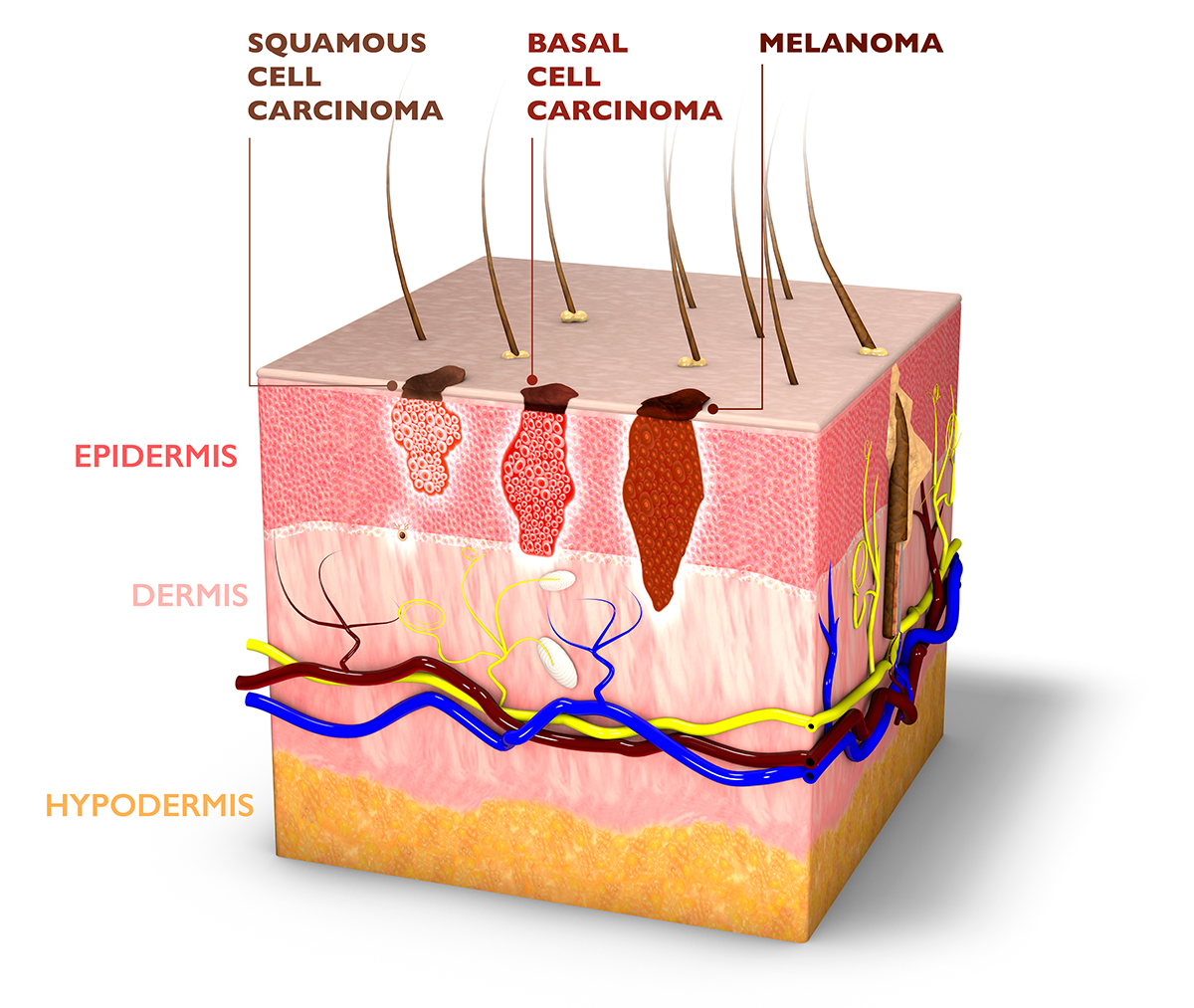
Types of Skin Cancer
Basal cell carcinoma: This is the most common form of skin cancer, and it is very curable. These cancers begin in the outer layer of skin (epidermis). Radiation therapy is very effective for treating basal cell cancers that have not spread elsewhere. Other common treatments include surgery, chemotherapy and cryosurgery.
Squamous cell carcinoma: This is the second most common type of skin cancer. These cancers also begin in the epidermis. Radiation therapy can be used to treat squamous cell cancers that start on the skin and sometimes nearby lymph nodes with or without surgery. Other common treatments include surgery, chemotherapy, cryotherapy and photodynamic therapy.
Melanoma: This is the most serious skin cancer; it begins in skin cells called melanocytes that produce skin color (melanin). Radiation therapy is used mostly for melanomas that started in another part of the body (metastases). It is used to treat areas where doctors think the disease may spread, such as lymph nodes in the head or neck area.
Treating Skin Cancer
Radiation therapy is an effective treatment option for certain types of skin cancer, particularly when surgery is not possible or when cosmetic or functional concerns make surgery less desirable. It works by directing high-energy X-rays or electron beams at the tumor to destroy cancer cells while preserving as much healthy tissue as possible. Radiation is often used for basal cell and squamous cell carcinomas located in sensitive areas—such as the face, ears, nose, or eyelids—where surgical scars might be noticeable or where surgery could affect function. It may be given as the primary treatment, after surgery to eliminate remaining cancer cells, or for advanced disease that has spread to nearby lymph nodes.
Treatment is usually delivered in a series of short, painless outpatient sessions over several weeks. Side effects are generally limited to the treated area and may include redness, dryness, itching, or crusting of the skin, which typically heal after treatment ends. In some cases, long-term skin changes such as discoloration or slight thinning may occur, but these are often mild. Radiation therapy offers excellent cancer control rates, especially for small or moderate-sized tumors, and your radiation oncologist will tailor the treatment plan based on the cancer type, location, and your overall health.
Potential Side Effects
The side effects you might feel will depend on the part of your body being treated, the dose of radiation given and whether you also receive other treatments like chemotherapy. Before treatment begins, ask your doctor about possible side effects and how you can best manage them.
Nearly all patients will experience redness and moistness of the skin, similar to a brisk sunburn. After treatment ends, the skin will form a protective scab and the new, healthy skin will develop underneath it. This healing make take several months. You will also likely lose your hair in the area treated. Your hair may grow back, but it might not have the same texture or thickness.

Contact Form
MACON
The Peyton Anderson Cancer Life Center
800 First Street
Suite 110
Macon, GA 31201
Phone: (478) 743-3466
WARNER ROBINS
114 Sutherlin Drive
Suite R
Warner Robins, GA 31088
Phone: (478) 287-6353